
Fat Attenuation Index · CaRi-Heart®
A view of
inflammatory activity
in the coronary arteries.
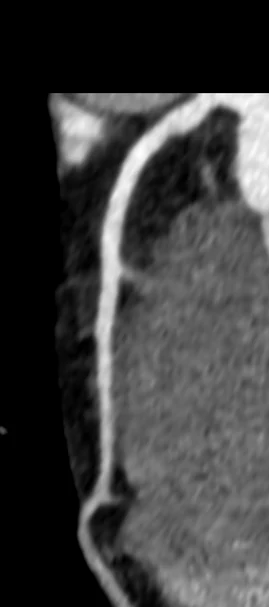
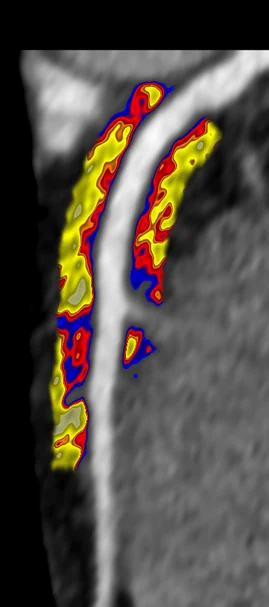
How can we gain a more detailed view of coronary health? FAI uses information from the fat surrounding the vessels to add to your individual risk assessment.
Why we take a closer look
Considering vessel structure
and inflammation together.
Plaque and narrowing are important parts of cardiac diagnostics. Inflammatory activity in the vessel wall offers another perspective: it may be relevant to individual risk assessment even without a major narrowing.
The Fat Attenuation Index measures changes in CT attenuation in perivascular fat. Caristo’s CaRi-Heart technology standardises this information and supports its clinical interpretation alongside the CT findings, your history and other risk factors.
Our approach
Four steps.
A personal overall picture.
- 01
Personal risk assessment
We discuss your history, symptoms and risk factors, and the clinical question that the additional analysis could address.
- 02
Suitable CT data
With our radiology partner, we review existing coronary CT images or arrange a scan when medically indicated.
- 03
CaRi-Heart analysis
Caristo analyses suitable images. FAI-Score adds an inflammatory signal to information about vessel structure and plaque.
- 04
Understand the findings. Plan prevention.
We interpret the report in your overall medical context and discuss clear next steps.
Your questions about FAI
Clearly explained.
How does the Fat Attenuation Index work?
Inflammatory processes in the vessel wall can change the fat directly surrounding it. These changes affect its CT attenuation. Standardised FAI analysis uses this signal as an indicator of coronary inflammatory activity.
How do FAI-Score and CaRi-Heart Risk differ?
FAI-Score describes coronary inflammatory activity relative to an age- and sex-matched reference population. CaRi-Heart Risk combines inflammation information with factors such as plaque, age and clinical risk factors. The measures and time horizon in the individual report apply.
Who may benefit from the assessment?
We assess whether coronary CT is medically appropriate or suitable CT images already exist, and whether inflammation analysis could add to your risk assessment. The supplied manufacturer instructions specify ages 30–80 for inflammation analysis and technical requirements for the images.
Will I need another CT scan?
If suitable coronary CT data are already available, FAI analysis uses those images and does not itself require another scan. If a new coronary CT is needed, we discuss its indication, contrast medium and radiation exposure with you and the radiology team beforehand.
How does FAI differ from calcium scoring?
Calcium scoring measures calcified deposits. Coronary CT angiography also assesses the course of the vessels, narrowing and plaque. FAI adds information about inflammatory activity around the vessels. Findings are interpreted together with your symptoms and risk factors.
What happens after the result?
We explain the findings in a personal consultation and consider them when discussing prevention and any further treatment. The report supports clinical assessment; a single score is not a diagnosis.
Is FAI included in my check-up?
FAI is an additional assessment using suitable coronary CT data. Its use depends on the clinical question and your individual or framework agreement. We clarify scope, costs and possible reimbursement beforehand.
Scientific background
Built on research.
The method grew out of research into coronary inflammation and has been evaluated in clinical cohorts. The studies and manufacturer information below form the basis of this explanation.
- ORFAN · The Lancet, 2024Inflammatory risk in patients with and without obstructive coronary disease.
- CRISP-CT · The Lancet, 2018Perivascular fat analysis and residual cardiovascular risk.
- Caristo Diagnostics · CaRi-Heart®Manufacturer information; also informed by the supplied CaRi-Heart Instructions for Use, © 2026.
Medical Center Düsseldorf
What is right for you?
We discuss whether the additional inflammation analysis could usefully complement your assessment.